Ginza Bars: Cover Charges, Drink Prices, Last Trains
Published cover charges from ¥0 to ¥1,500, per-drink prices at four Ginza bars, walk-in versus referral-only doors, and the last trains from Ginza and Yurakucho stations.
Contents
Ginza does not have a cocktail price. It has four prices that land on the same bill, and the largest number on the menu is often not the one that decides what you pay.
Here is what you can use: the cover charge at four bars that publish one, the price of a drink at each, which doors open to a stranger, and when the trains stop. Every figure was checked on 24 October 2026 against the venue’s own site or the operator’s timetable. Prices change; the links let you re-check.
Where the bars are, and which exit to use
Ginza runs north to south, 1-chome at the Kyobashi end to 8-chome at the Shimbashi end. Chuo-dori is the wide street with the department stores. One block west and parallel runs Namiki-dori, where GINZA SIX stands in 6-chome. The western edge is the JR viaduct: Yurakucho Station underneath it, and the Sukiyabashi crossing where Ginza meets Yurakucho.
That geography decides your night more than any ranking does. Ginza Corridor Street carries a Yurakucho address, not a Ginza one: the strip of small bars under the JR tracks runs from Yurakucho toward Shimbashi. The quiet, expensive cocktail rooms sit mostly in 6-chome and 7-chome, on the side streets off Namiki-dori.
Approaches, from the venues’ own access notes:
- Ginza Station, exit A3: about two minutes to GINZA 300BAR 5-chome.
- Hibiya Station, exit A4: about four minutes to 300BAR NEXT, which sits on the Yurakucho side.
- Shimbashi Station, Ginza exit: about two minutes to 300BAR 8-chome, the Corridor Street branch.
- Yurakucho Station: the closest station to the Corridor Street end and to Namiki-dori’s northern blocks; JR Yamanote and Keihin-Tohoku, plus the Yurakucho Line.
The 6-chome and 7-chome rooms sit within a few blocks of both Ginza Station and Yurakucho Station. The Kabuki-za end belongs to Higashi-Ginza Station, a different walk and a different crowd.
The bill has four layers
The charge is not a scam and not a tip. It is rent, ice, glassware and a seat. Once you know the four lines, the total stops being a surprise.
- Charge (チャージ) or seat charge (席料). Per person, per visit, before you drink anything. Sometimes called an entrance fee (入店料).
- The drink. Priced per glass, and at some bars sold as tickets instead of a menu.
- Service charge (サービス料). A percentage added at the end, or explicitly not charged.
- Consumption tax. The trap. Some bars quote prices with tax included; some mark them 税別 (tax excluded), and you add 10% at settlement.
A fifth line exists in some rooms: a small dish arrives without your ordering it. That is otoshi, and where a bar serves one it is normally part of the charge rather than a gift. Ask, and you will get a straight answer.
The four bars below stack the layers differently: one charges nothing, another adds a percentage to the entrance fee.
Four bars, with the numbers published
| GINZA 300BAR 5-chome | GINZA SOUL GARDEN | BAR ANTHEM | BAR GOYA | |
|---|---|---|---|---|
| Cover charge | None | ¥880, tax included | ¥1,500, tax excluded | ¥1,100 entrance fee |
| Service charge | None | None | Not stated | 10% |
| One drink | ¥300 per ticket, tax excluded, minimum 3 | ¥550 at happy hour, tax included | Martini ¥1,600; gin and tonic ¥1,800 | Whisky from ¥1,650; cocktails ¥1,980–2,530 |
| Hours | Sun–Thu 16:30–24:00; Fri, Sat and days before holidays 16:30–02:00 | Mon–Fri 18:00–02:00; Sat 18:00–24:00; closed Sun and holidays | Mon–Fri 18:00–02:00; Sat, Sun and holidays 18:00–23:00 | 16:30–23:30, last order 23:00 |
| English | English site and English menu | English site | No English site | No English site |
| Dress code | Not published | Not published | Not published | Not published |
GINZA 300BAR is Japan’s self-described first standing bar, open since 1992. The ticket system is the whole point: ¥300 a ticket, three minimum, no cover, so three drinks cost ¥900 before tax. You stand, you talk to strangers, you leave when you like.
GINZA SOUL GARDEN is a music bar in 7-chome playing 70s and 80s soul. The ¥880 cover includes tax and there is no service charge, which makes it one of the few rooms here where the number you read is the number you pay. Happy hour runs 18:00–19:30 at ¥550 a drink. Smoking is permitted throughout, cards are accepted, e-money and QR payments are not.
BAR ANTHEM is a 6-chome cocktail bar run by Jun Asakura, national champion in 2005. The charge is ¥1,500 and the site marks it as tax excluded, so budget ¥1,650 before your first drink. The site is Japanese only.
BAR GOYA is the expensive end, and the most instructive. Entrance ¥1,100, service 10%, a whisky from ¥1,650, a stirred cocktail from ¥2,200, a seasonal fruit cocktail from ¥2,530. One person, one cocktail: ¥1,100 plus ¥2,200 plus 10% service is ¥3,630 before the tax question, which the menu page does not settle either way. Ask.
Walk-in, or introduction only?
This is the line that separates a good night from a closed door, and the venue’s own site usually says so first.
BAR GOYA states it plainly: entry is by introduction, from someone the owner knows, and a social media or map-listing contact does not count. The same page lists the entrance as reachable only from the back alley, bans photography and video, bans phone calls and smoking, and asks guests not to exchange business cards. All of that is published, not rumoured.
Compare 300BAR, which posts hours, prices and three branch addresses in English, or Soul Garden, which publishes its cover charge, payment methods and smoking policy on an English page. A bar that wants foreign customers says so somewhere you can read.
Three signals to check before you go:
- The words 紹介制 (referral system) or 会員制 (membership system) on the site. Either one means you cannot simply turn up.
- No price list anywhere, only photographs of the room and a phone number. Not proof of anything, but a reason to call first.
- At the door: a nameplate with no menu, an intercom instead of a handle, a sign reading Members Only. Ring and ask, or walk on.
One rule holds across the district. Do not accept an invitation from someone on the street. The Tokyo Metropolitan Police publishes warnings about touts who lead visitors to bars with inflated bills, and a bar that needs a recruiter on the pavement is not the bar you want.
What two bars cost, in yen
Two stops, one person, published prices only. Both routes start at 300BAR, which opens at 16:30.
The cheap route. Three tickets at 300BAR: ¥900 plus 10% tax, so ¥990. Then Soul Garden before 19:30: ¥880 cover plus two drinks at ¥550, so ¥1,980. Total ¥2,970 for five drinks across two bars, roughly ¥594 a drink with the seats included.
The same shape, one tier up. BAR ANTHEM first: ¥1,500 charge plus a ¥1,600 martini is ¥3,100, plus 10% tax, so ¥3,410. Then Soul Garden’s cover and two happy-hour drinks at ¥1,980. Total ¥5,390 — for three drinks, not five.
That is nearly twice the first bill. The gap itemises cleanly: ¥1,650 of it is Anthem’s charge with tax, ¥1,760 is the martini with tax, and ¥990 bought three drinks at 300BAR.
One caution: 300BAR marks its tickets as tax excluded, and ANTHEM marks its charge the same way, so both sums add 10%. If a menu includes tax, subtract it. Ask before you order, not at the register.
Hostess bars, cabaret clubs, and Ginza “clubs”
These are three different products. A bar sells drinks and a seat. The others sell time and attention, and the meter runs whether or not you are thirsty.
- A hostess bar is a bar with hostesses who sit and talk with guests. Billing is usually a charge plus drinks, with the companion’s drinks added to your bill.
- A cabaret club (キャバクラ) sells named time blocks (a set number of minutes), plus a nomination fee for a specific hostess, plus extensions when the block runs out.
- A Ginza club is the high-end version, often run on introductions and monthly billing for regulars, with a per-hour seat charge and bottle keep.
The practical consequence: at a cabaret club the clock is the product, and extensions are where the bill grows. At a bar, the clock is free and the glass is the product. If a venue quotes you a time block, you are not in a bar, whatever the sign says. Hostess bars and host clubs are covered separately, since the etiquette differs as well as the fee.
The last train is earlier than you think
Ginza empties fast after midnight, and the three subway lines under the station do not leave together. These are the last departures on the weekday timetable checked on 24 October 2026, from the operators’ own pages.
| Station | Line and direction | Last departure |
|---|---|---|
| Ginza | Ginza Line to Shibuya | 00:13 |
| Ginza | Ginza Line to Asakusa | 00:07 |
| Ginza | Marunouchi Line to Shinjuku | 00:13 |
| Ginza | Hibiya Line to Naka-meguro | 00:18 |
| Yurakucho | Tokyo Metro Yurakucho Line to Ikebukuro | 00:14 |
| Yurakucho | JR Yamanote, outer loop to Shinagawa | 00:48 |
The Ginza Line also runs a final 00:18 departure that terminates at Ueno rather than continuing to Asakusa. Opposite platforms and weekend timetables differ. Check the day you travel: Tokyo Metro’s Ginza Station timetable and JR East’s Yurakucho timetable.
The Yamanote at 00:48 is the outlier: if your hotel sits on the loop, Yurakucho buys you half an hour more than Ginza Station. Otherwise, plan around the subway.
Manners that change your bill
Otoshi. A small dish that appears unasked is usually inside the charge. If it is not, you are entitled to say so.
Cash or tab. Some bars take payment per drink; others run a tab and settle at the end. Soul Garden publishes card acceptance and no e-money; GOYA’s page says nothing about payment. Carry cash — a ¥10,000 note is normal; a card is not guaranteed.
Tipping. Do not. A service charge, where it exists, is already on the bill, and extra money on the table usually causes a puzzled conversation.
Photographs. GOYA bans them outright, including video. Elsewhere, ask. The objection is rarely the cocktail; it is the other guests in the frame.
Smoking. Soul Garden permits it throughout; GOYA bans it, e-cigarettes included. Both publish it; read the site rather than assume.
ID. The drinking age is 20, and the passport is the document that always works.
Pick two bars, not five. Read the charge before you sit down, ask whether the menu includes tax, and leave enough margin to reach the right platform. That is a better night than chasing a list.
Sources, all checked 24 October 2026: Ginza Official; GINZA SIX; Tokyo Metro – Ginza Station; JR East – Yurakucho timetable; Japan Bartenders Association; Tokyo Metropolitan Police – advice to visitors.
For a cheaper, denser district with published visitor rules, see Golden Gai; for tiny specialist bars without Ginza’s price floor, Shinjuku’s niche bars. For a dance floor instead of a bar stool, Roppongi is the other direction.
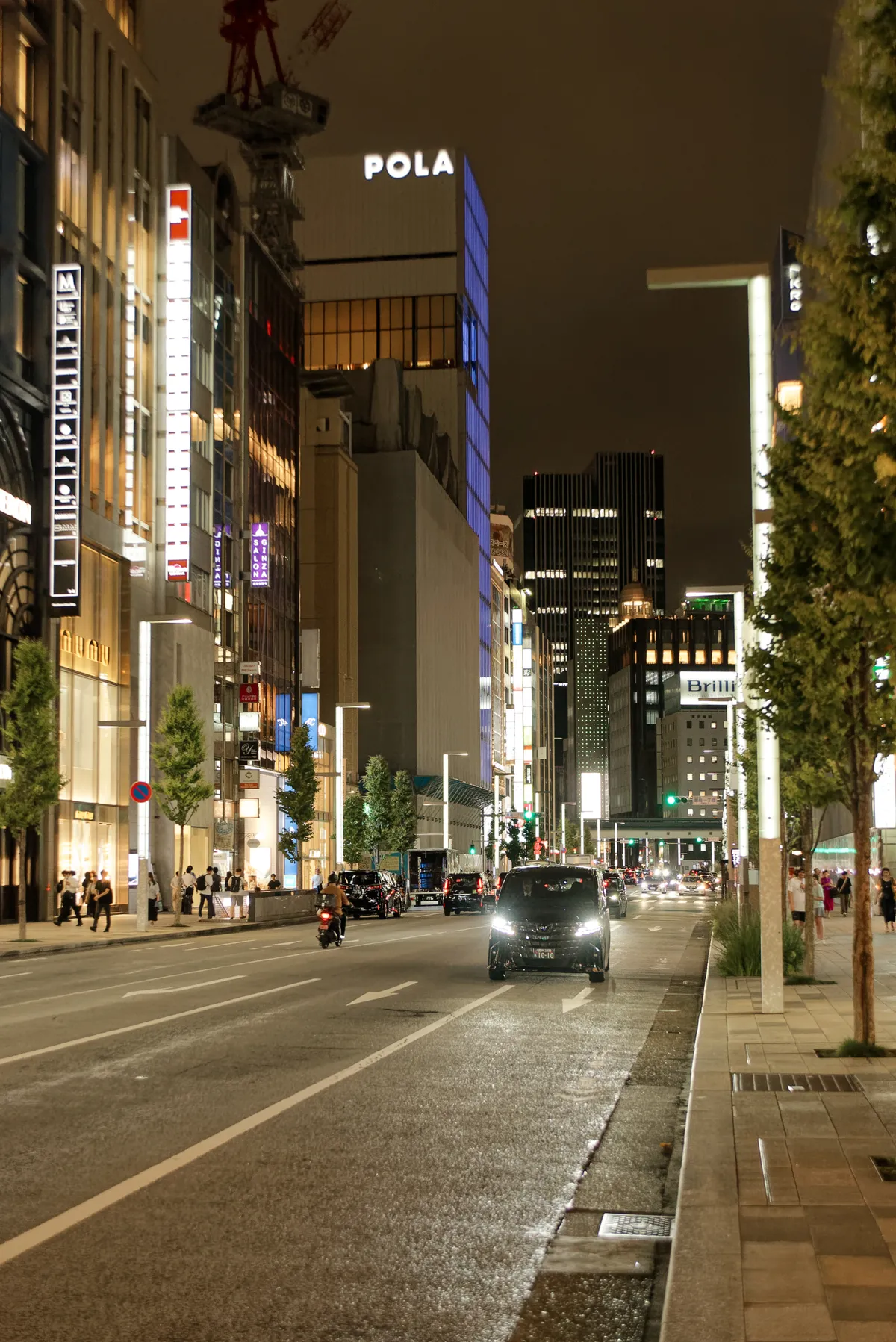
Photo: Ginza at night by Jakub Hałun, Wikimedia Commons, CC BY 4.0.
Frequently asked questions
Do Ginza bars charge a cover?
Many do, and the amount is set per venue. Of the four bars checked here, GINZA 300BAR charges no cover but requires three ¥300 tickets, GINZA SOUL GARDEN charges ¥880 including tax, BAR ANTHEM charges ¥1,500 before tax, and BAR GOYA charges a ¥1,100 entrance fee plus 10% service.
Can I walk into a Ginza bar without a reservation?
At some bars, yes. GINZA 300BAR is a standing bar with an English site and no introduction requirement, and GINZA SOUL GARDEN publishes its cover charge and rules in English. Others are referral-only: BAR GOYA states on its own site that it admits only guests introduced by someone the owner knows.
How much is one cocktail in Ginza?
There is no district price. Published figures run from ¥300 a ticket at GINZA 300BAR to ¥550 for a happy-hour drink at GINZA SOUL GARDEN, ¥1,600 for a martini at BAR ANTHEM and ¥2,530 for a fruit cocktail at BAR GOYA. Compare the cover charge as well as the drink.
When is the last train from Ginza Station?
On the weekday timetable checked on 24 October 2026, the last Ginza Line train to Shibuya left at 00:13, the last Marunouchi Line train to Shinjuku at 00:13, and the last Hibiya Line train to Naka-meguro at 00:18. Saturday and holiday timetables differ.
Do I need to dress up for a Ginza bar?
None of the four bars checked publishes a dress code. A jacket is not a stated condition of entry at any of them. The rules they do publish are about behaviour: BAR GOYA bans photography, phone calls and smoking, and asks guests not to exchange business cards.

Written by
CHONMAGE
CHONMAGE publishes English-language explanations of Japan's nightlife and adult-entertainment topics. We distinguish sourced legal and operator rules from estimates; venue prices, access policies and eligibility should be checked with the operator before visiting.
Keep reading