Japanese OnlyFans: Finding Real Accounts, Spotting Fakes
Japanese performers on OnlyFans are real; the accounts claiming to be them often are not. Where the trail starts, five checks before you pay, and how dollar billing works.
Contents
- What you are signing up to
- Four routes that lead to a page worth checking
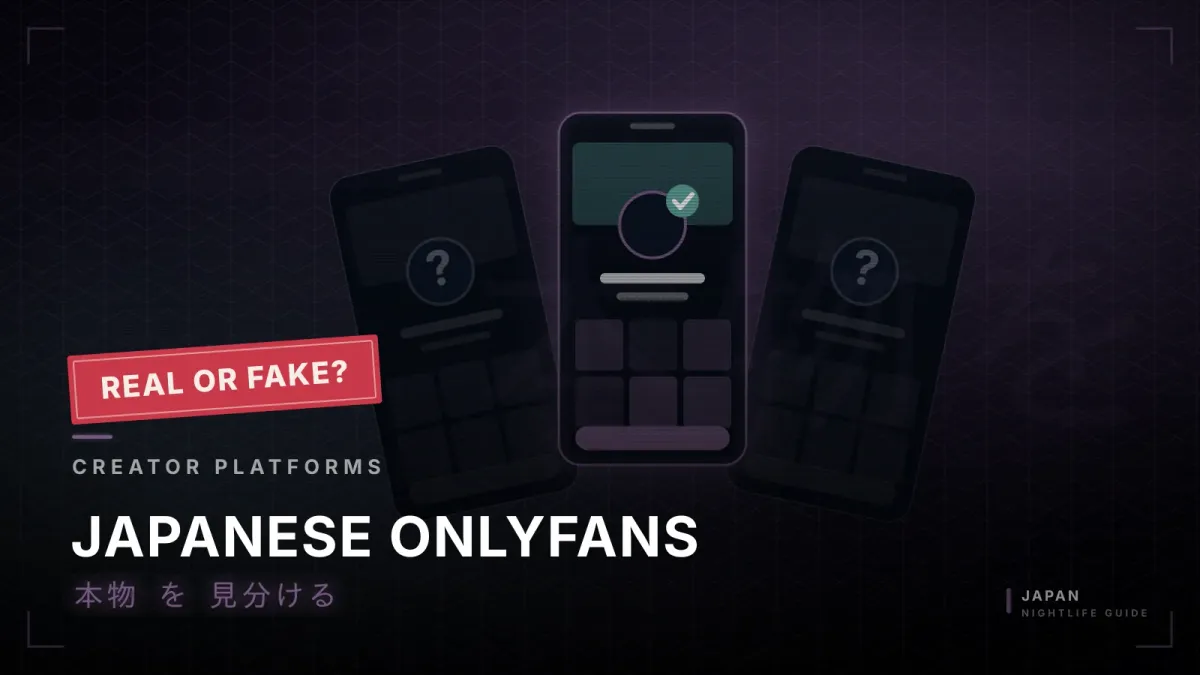
- Five checks, in the order that saves you money
- 1. Start from the link list, not the platform
- 2. Read the posting dates, not the follower count
- 3. Match the announcement
- 4. Check that the links point both ways
- 5. Reverse-image-search one photo
- Three shapes of fake account
- Paying in dollars from outside Japan
- Why some Japanese performers are on it and some are not
- What a subscription buys
- If it goes wrong
- Sources
Checked 24 October 2026 against OnlyFans’ own terms and contract, X’s authenticity rules, and the Japanese reporting windows listed at the end. Payment details move fastest, so confirm anything about money on the platform page before you type a card number.
Search for Japanese OnlyFans and you get lists. Ten names, a ranking, no evidence. They are cheap to produce and stale within a month, and some accounts on them belong to someone who downloaded a performer’s photos and started charging for them.
Skip the list. The skill worth having is narrower: find the page a Japanese performer runs, then establish in ten minutes whether the account taking your money belongs to her.
What you are signing up to
OnlyFans is a British company, Fenix International Limited, registered in England and Wales under company number 10354575. Nothing about the platform is Japanese except some of the people on it. No Japanese section, no country filter, no browsable directory.
Two lines from the terms of service shape everything below.
- Every price is in US dollars. Your issuer converts. A yen figure quoted in a blog post is somebody’s arithmetic, not a price.
- Creators are identity-checked. Opening a creator account requires a valid ID and two photographs of yourself (section 6.2).
That check is real and narrow: it proves an adult human passed verification, not that the human is the performer whose name you typed.
Four routes that lead to a page worth checking
| Route | What it gives you | Why it holds up |
|---|---|---|
| X profile | A bio and a link list the performer maintains | Years of posts cost money to fake, and X bans identities built on stolen photos or copied bios |
| Launch announcements, stories, one bio link | The account announcing a page is usually older than the page itself | |
| Agency site | A roster entry listing her channels | A business record rather than a post |
| FANZA profile | Release credits under a performing name | A work history ties the name to a body of work, not to a payment page |
The FANZA performer index is age-gated and Japan-facing, a separate problem covered in FANZA from overseas. You are not shopping there; it is a public record of who worked under which name.
Most performers also keep a domestic presence; many run a profile on MyFans, the Japan-run subscription platform. The same face on both is a second independent record.
One snag catches everyone: performing names are stage names, and each exists in two or three romanisations, with and without macrons, family name first or last. Search the Japanese characters too; a performer with an active account can stay invisible because a studio romanised her name differently in 2019.
Five checks, in the order that saves you money
1. Start from the link list, not the platform
Find her own profile first, then follow the link out of it. If the OnlyFans address appears only inside an article, an aggregator or a DM, you have a claim rather than a confirmation. Repost accounts rarely get a link from the real person, who does not control them.
2. Read the posting dates, not the follower count
A genuine account has a rhythm: bursts around shoots, quiet weeks, a gap when someone was ill. Scroll to the oldest posts and check the span, then whether the same room recurs. An account three weeks old with nine hundred posts is a content mill, and the mill is not her.
3. Match the announcement
When a Japanese performer opens or pushes an account, she says so on X, handle written out. Go and find that post. If the account claims to be her and her timeline never mentions it, that silence is your finding.
4. Check that the links point both ways
A single hop proves little. A closed loop is expensive to fake: X links to Instagram, Instagram links to the agency, the agency lists both, and the subscription page points back at X. Any one link can be manufactured. All four at once takes effort, and effort is what a scraped operation avoids.
5. Reverse-image-search one photo
Take a clear, unwatermarked photo from the subscription page and run it through Google Images and TinEye. If the same frame sits on a studio title page, a magazine gallery or another account from two years earlier, the page is reusing material.
Five checks, one browser session, nothing paid. Run them before the subscription; afterwards you are arguing with a support queue in a second language.
Three shapes of fake account
The recycled gallery. Photos lifted from a title, a gravure shoot or a real performer’s public posts, presented as original work. The tells are small: image quality that jumps between posts, a face that never appears twice in the same room.
The DM that leaves the platform. A message arrives within an hour of subscribing, the conversation slides to another app, then comes the payment route: gift cards, crypto, a bank transfer. Every one moves your money past the only dispute mechanism you have and breaches the platform’s terms.
The volume account. Hundreds of posts in a fortnight, captions that would fit any creator alive, DMs in fluent English from an account posting entirely in Japanese, or the reverse. A second voice sometimes appears, calls itself management, and writes differently. That is a reseller running several pages from one desk.
The pattern under all three is the same. The effort went into the shopfront, not into the person.
Paying in dollars from outside Japan
Each creator sets a price, the platform charges it in dollars, and the profile number is not the number you pay. Count the parts: subscription, any pay-per-view post, tips, and your bank’s foreign transaction fee, usually between nothing and 3%.
A $9.99 plan, one $15 pay-per-view post and a 3% fee lands near $25.75 for the first month. The subscription is the smallest line in that total.
The card step is where foreign subscribers quit, and the cause is usually dull. Adult content sits in a merchant category some issuers block by policy, and a dollar charge from a British processor looks strange to a bank that mostly sees domestic spending. The first payment may also trigger a 3-D Secure challenge, the one-time code your bank asks for, which times out silently inside an in-app browser.
What helps, in order:
- Pay in a normal browser tab, not an in-app webview.
- Keep your banking app open so the challenge is approved before it expires.
- Call the issuer and ask whether the block is policy or fraud scoring.
- Try a card from a different bank. Risk rules are set per issuer.
Renewal is the part people forget. A subscription renews automatically unless one of four things happens: you switch off auto-renew on that creator’s account, the price rises, a payment is declined, or you close your account (terms, section 9.10). Cancel and you keep access until the paid period ends, then payments stop. Do it from the subscription settings and keep the confirmation. Deleting the app cancels nothing.
Wallet credit is not a refund route: it is non-refundable, and a purchase cannot be split across it. Chargebacks are a fraud tool rather than a complaints form. The terms treat an unjustified chargeback as grounds for suspending your account.
Why some Japanese performers are on it and some are not
This is a contract question more than a platform question. Japanese adult work runs through agencies, and an agency’s position on direct selling is negotiated performer by performer. Some rosters permit it, some treat it as a breach, and plenty sit in between, allowing a separate name and separate content.
Personal reasons vary as much. A direct account means setting your own price and talking to buyers yourself. Studio work means a production schedule, a contract and somebody else handling distribution. Some run both as one business; others keep them apart, names included.
Language pulls the same way. OnlyFans bills in dollars and runs in English; MyFans is Japanese-first with a translated interface and mostly domestic buyers. A performer whose audience sits in Japan has little reason to move; one who wants a foreign audience does.
An empty search means you have not found the page, not that it does not exist. Only the first of those is yours to fix.
What a subscription buys
You buy access for a period, not a copy. The fan-creator contract is blunt: the creator grants a licence to view the content, that licence carries no ownership rights, and it expires when the subscription period ends, the content is deleted, or your account closes.
In ordinary terms:
- Watching what you paid for, while you are paying, is the product.
- Downloading and reposting is copyright infringement and, on the platform, a ban.
- Screenshots into a group chat, a reupload to a video site, a traded folder, a leak account: same category. Japanese copyright law protects the work, not just the file.
- Stripping a watermark to repost is the version that gets pursued: it removes the evidence and the credit in one step.
The rights usually sit with whoever produced the work rather than with the face in it. That side of the industry is mapped in how JAV actresses’ careers work, and the pricing mechanics on the Japanese platform are in what MyFans plans actually cost.
If it goes wrong
Order matters.
Report on the platform. The complaints policy is the only route that can act on the account itself.
Report the impersonation where it lives. If the fake is on X, use the impersonation form. X’s authenticity policy covers identities built on stolen profile photos and copied bios.
In Japan, police channels are for crimes. The National Police Agency’s cyber window takes reports and requests for advice online. Tokyo residents can call the Metropolitan Police Department’s cyber desk on 03-5805-1731, weekdays 8:30 to 17:15. Anything urgent goes to 110, not a web form.
Money problems go to the consumer channels. From inside Japan, the Consumer Affairs Agency’s hotline is 188. For a dispute with a business based abroad, which a UK-registered platform is, the cross-border consumer centre handles that case specifically.
Unauthorised card charges go to the issuer first. Reporting deadlines are measured in weeks, and a charge you never made is a different claim from a subscription you regret.
Find the person before you find the page. Read dates, not follower counts. Make the links close the loop. Pay inside the platform, in dollars, with a card your bank will authorise, and switch auto-renew off the day you subscribe.
Sources
All sources checked 24 October 2026.
- OnlyFans terms of service: pricing, creator ID, renewal, chargebacks.
- OnlyFans contract between fan and creator: licence scope and expiry.
- OnlyFans complaints policy: reporting route.
- X authenticity policy: fake personas and impersonation.
- X impersonation report form.
- National Police Agency cyber consultation.
- Metropolitan Police Department cyber desk.
- Consumer Affairs Agency, consumer hotline 188.
- National Consumer Affairs Center, cross-border centre.
- MyFans English site.
- FANZA performer index.
- Google Images and TinEye: reverse image search.
Frequently asked questions
Does OnlyFans have a Japanese version?
No. The interface is English and every price is charged in US dollars. Japanese performers post in Japanese, so the page works and the captions do not translate. MyFans is the Japan-run subscription platform with an English interface, and it is a separate company with separate accounts.
How do I confirm an OnlyFans account belongs to a performer I found on X?
Work backwards from her own profile. The subscription link should sit in the link list she controls, her timeline should mention the account, and Instagram or her agency page should point at the same handle. If the OnlyFans URL exists only inside someone else’s article, treat it as unconfirmed.
Is the verification badge proof that the account is the performer?
It proves an adult passed the platform’s identity check, which requires a valid ID and two photographs. That makes the account real and payable. It does not tie the account to the specific name you searched, because anyone who passes the check can register any available username.
Can I repost content I paid for?
No. A subscription grants a licence to view, not ownership, and the licence ends when the subscription period ends. Reuploading, trading folders or stripping a watermark is copyright infringement and gets the account closed.
Why is a Japanese performer charging in dollars?
Because the platform prices and charges everything in USD regardless of where the creator lives. Your bank converts at its own rate and may add a foreign transaction fee, so two subscribers on the same plan can pay different amounts.

Written by
CHONMAGE
CHONMAGE publishes English-language explanations of Japan's nightlife and adult-entertainment topics. We distinguish sourced legal and operator rules from estimates; venue prices, access policies and eligibility should be checked with the operator before visiting.
Keep reading